AI-Driven
Predictive models project compensatory changes in unfused spinal segments for adult deformity, pediatric, and degenerative procedures.
AI-planned, pre-contoured spinal rods built to each patient’s target alignment — giving Dr. Hobbs a precise template for durable correction in complex and deformity spine surgery.
The rods used in spinal fusion hold the spine in its corrected position while it heals. UNiD™ translates an approved alignment plan into a physical, patient-specific template for the operating room.
A different approach: Traditionally, the surgeon bends rods by hand in the operating room to match the desired curve. UNiD rods are industrially pre-bent to an AI-driven plan created from the patient’s imaging and target spinopelvic alignment.
Designed for complex correction: UNiD rods are FDA-cleared for use with Medtronic’s spinal fixation systems and are used to treat adult spinal deformity, scoliosis, and complex degenerative conditions.
Dr. Hobbs combined Medtronic’s patient-specific UNiD™ rods with Carlsmed’s patient-specific aprevo® TLIF interbody cages in a two-level lumbar fusion (L4–S1) at Northwest Health – Porter in Valparaiso, the first two-level fusion in the United States to pair the two technologies. The rods were manufactured to the approved alignment plan before surgery rather than bent by hand in the operating room, and the cages and rods were anchored with standard pedicle screws.
Follow-up interview, October 9, 2026: Becker’s asked Dr. Hobbs where personalized implants go next. “Patient-specific technology offers another way to translate a detailed preoperative plan into the final construct. The objective is not customization for its own sake; it is greater precision and reproducibility.” Read the highlights.
Achieving harmonious alignment of key spinopelvic parameters — such as the sagittal vertical axis (SVA), pelvic incidence/lumbar lordosis mismatch (PI-LL), and pelvic tilt (PT) — is a central goal of spinal deformity surgery.
Patients whose postoperative spinopelvic parameters fall within normative ranges tend to exhibit improved patient outcome scores. Getting alignment right is exactly what patient-specific rods are designed to help achieve.
Patient-specific alignment makes a difference.
In a study by Sardi et al., ten experienced surgeons were asked to contour rods with a French bender to 40, 60, and 80 degrees.
Without a template, the surgeons overbent by a mean of 17.5 to 20.2 degrees for each desired angle. With a template, they came within an average of about two degrees of their target. A pre-bent UNiD rod gives Dr. Hobbs that template-level precision built in.
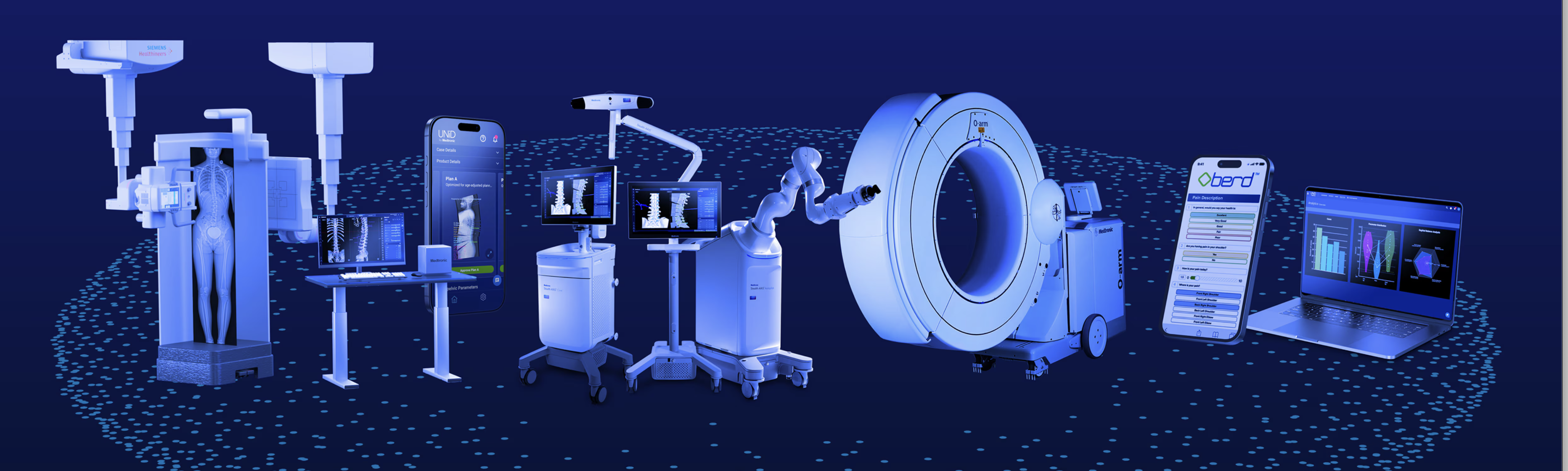
From planning to post-operative review, the UNiD ASI workflow keeps the surgical plan connected at every step.
Patient images and data are brought together for planning.
AI-driven surgical plans are created through the AiBLE™ clinic.
UNiD™ rods are manufactured to the approved alignment plan.
The Stealth AXiS™ system helps execute the plan precisely.
LiveAlign™ tracking helps confirm the plan in real time.
Post-operative data is reviewed against the planned result.
Planning, manufacturing, navigation, and learning are connected around the approved surgical plan.
Predictive models project compensatory changes in unfused spinal segments for adult deformity, pediatric, and degenerative procedures.
Dedicated engineers deliver complete surgical plans, including alignment goals, predictive models, and corresponding rod shape.
UNiD™ rods are designed from the approved plan, providing a precise intraoperative template.
The GAiTEWAY™ platform aggregates data across cases to identify trends and support continued refinement.
Connected systems help surgeons plan, execute, reconcile, and analyze within one technology ecosystem.
According to Medtronic’s published postoperative data analysis, UNiD™ rods are associated with a lower incidence of rod fracture compared with historic International Spine Study Group (ISSG) data.
Figures reflect Medtronic’s published comparison of UNiD™ rod postoperative data against historic International Spine Study Group datasets with comparable parameters. These are device-level data, not Dr. Hobbs’s individual outcomes, and individual results vary.
If you're facing spinal deformity or complex fusion surgery, ask Dr. Hobbs how patient-specific rods and AI-driven planning can help achieve a precise, lasting correction. Call today to schedule a consultation.
(219) 250-5010Monday – Friday · 8:00 AM – 4:30 PM
500 E. 109th Avenue
Crown Point, IN 46307
601 Gateway Boulevard
Chesterton, IN 46304
Your next step
Jonathan G. Hobbs, M.D. is a board-certified neurosurgeon at Lakeshore Bone & Joint Institute. For questions about medtronic unid™ patient-specific rods, call the office to arrange an individual evaluation and discuss which options may be appropriate.
Consultation offices: Crown Point, Chesterton. Your symptoms, examination, imaging, and prior treatment help guide the discussion.
Page updated . About content and medical review dates.