Home / Procedures / TOPS System
Motion-Preserving Procedure First in Indiana

Premia Spine TOPS™ System

An FDA-approved alternative to spinal fusion that relieves the leg and back pain of lumbar spinal stenosis and spondylolisthesis — while preserving your spine's natural motion. Dr. Hobbs was the first surgeon in Indiana to perform the TOPS procedure.

Call (219) 250-5010
Medically reviewed by Jonathan G. Hobbs, M.D. · Updated June 2026

Dr. Jonathan Hobbs was the first surgeon in Indiana to perform the Premia Spine TOPS procedure — bringing this motion-preserving technology to patients across Northwest Indiana.

Premia Spine — maker of the TOPS System

What Is the TOPS System?

The TOPS System — short for Total Posterior Spine System — is an FDA-approved spinal implant that treats lumbar spinal stenosis and degenerative spondylolisthesis while preserving the natural movement of the spine. It is a form of lumbar facet arthroplasty, meaning it replaces the function of the small spinal joints (the facet joints) that are removed during decompression surgery.

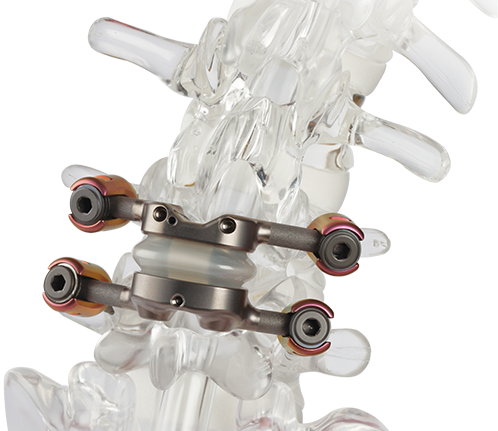
The device itself is made of two titanium plates connected by a mechanical articulating core. After Dr. Hobbs relieves the pressure on the nerves with a standard decompression, the TOPS implant is anchored across the treated segment. Rather than locking the vertebrae together the way a fusion does, it stabilizes the spine while still allowing controlled bending, extension, and rotation.

The TOPS System was designated an FDA Breakthrough Device and received FDA Premarket Approval (PMA) in June 2023 — with a label indicating superiority to fusion based on the results of its pivotal clinical trial. It is the first posterior motion-preserving device of its kind approved for this combination of conditions.

See How the TOPS System Works

This short animation from Premia Spine shows how the TOPS device stabilizes the lower spine while preserving natural motion.

How the TOPS Procedure Works

Decompression

Dr. Hobbs first performs a decompression, removing the bone and thickened ligament that are narrowing the spinal canal and pressing on the nerves. This is what relieves the leg pain, numbness, and difficulty walking caused by spinal stenosis.

Stabilization with the TOPS Implant

Because a decompression for spondylolisthesis can leave the segment unstable, that stability has to be restored. Instead of fusing the vertebrae, Dr. Hobbs anchors the TOPS device to the spine above and below the treated level, recreating the support normally provided by the facet joints.

Preserved Motion

The implant's articulating core allows the treated segment to keep bending, extending, and rotating in a controlled way. Preserving this motion is intended to protect the discs and joints above and below from the added stress that often follows a fusion.

Do You Qualify — and What Are the Benefits?

The TOPS System is approved for a specific group of patients. The graphic below summarizes who may qualify and the advantages the device offers over traditional fusion.

You may qualify for the TOPS Lumbar Motion Device if you have spinal stenosis or spondylolisthesis, no disc herniation, and Medicare or other medical insurance. Benefits: addresses leg and back pain, preserves motion with no fusion, clinical superiority, and FDA and Medicare Breakthrough Device.

You may qualify if you:

  • Have lumbar spinal stenosis with spondylolisthesis at a single level
  • Have no significant disc herniation at the level being treated
  • Have not improved after 6+ months of nonsurgical treatment
  • Have Medicare or other medical insurance

Your potential benefits:

  • Addresses leg and back pain from stenosis and spondylolisthesis
  • Preserves motion — no fusion and no permanently locked segment
  • Clinical superiority to fusion in the FDA pivotal trial
  • FDA & Medicare Breakthrough Device

Candidacy is determined individually. Dr. Hobbs reviews your symptoms, examination, and MRI and X-ray imaging to confirm whether the TOPS System is appropriate for you.

TOPS System vs. Spinal Fusion

For decades, the standard surgical treatment for spinal stenosis with spondylolisthesis has been decompression plus spinal fusion, which permanently joins the affected vertebrae to stop painful motion. Fusion is effective, but locking a segment can place extra stress on the discs and joints above and below — a phenomenon known as adjacent-segment degeneration — sometimes leading to new problems and additional surgery years later.

The TOPS System was studied head-to-head against fusion in a rigorous FDA pivotal trial that randomized patients with lumbar spinal stenosis and degenerative spondylolisthesis to either TOPS or fusion. The motion-preserving approach outperformed fusion across the trial's key measures:

77%

overall clinical success at 2 years with TOPS, vs. 24% with fusion

Motion

preserved at the treated segment at 2 years, rather than eliminated by fusion

Lower

reoperation rate in the TOPS group compared with the fusion group

Results reported from the Premia Spine TOPS pivotal Investigational Device Exemption (IDE) study. Individual results vary, and the TOPS System is not appropriate for every patient or every type of spinal condition. Dr. Hobbs will discuss whether fusion or a motion-preserving approach is the better option for your specific situation.

Recovery and What to Expect

Because the TOPS procedure preserves motion instead of fusing the spine, recovery often avoids the prolonged bracing and bone-healing timeline that a fusion requires. Many patients notice early relief of their leg and back pain and are encouraged to get up and walk the day of surgery.

Day of Surgery

Patients are typically encouraged to stand and walk the same day. Many experience immediate relief of the leg pain caused by nerve compression.

First Few Weeks

Activity is gradually increased under Dr. Hobbs's guidance. Because there is no fusion to heal, many patients return to light daily activities sooner than they would after a fusion.

Ongoing Recovery

Physical therapy may be used to rebuild strength and flexibility. Dr. Hobbs monitors your progress at follow-up visits and tailors your recovery plan to your condition and goals. Recovery timelines vary from patient to patient.

Why Choose Dr. Hobbs for the TOPS Procedure

First in Indiana
Dr. Hobbs was the first surgeon in Indiana to perform the Premia Spine TOPS procedure
Board-Certified Neurosurgeon
Specialty-trained in spine surgery, including spinal tumors and complex deformities
Elite Training
University of Kentucky medical degree; neurosurgery residency at the University of Chicago, serving as chief resident
Fusion and Motion-Preserving Options
Experienced in both fusion and motion-preserving techniques, so your treatment is matched to your anatomy and goals
Advanced Technology
Image-guided StealthStation navigation and AI-assisted surgical planning for precise, individualized care
Lakeshore Bone & Joint Institute
Practicing at Northwest Indiana's most preferred orthopedic and spine practice

Frequently Asked Questions About the TOPS System

The TOPS (Total Posterior Spine System) is an FDA-approved spinal implant that treats lumbar spinal stenosis and degenerative spondylolisthesis while preserving the spine's natural motion. After Dr. Hobbs performs a decompression to relieve pressure on the nerves, the TOPS device — two titanium plates connected by a mechanical articulating core — is implanted to stabilize the segment without locking it in place. It is a motion-preserving alternative to spinal fusion.
Spinal fusion permanently locks the treated vertebrae together to stop painful motion, which can place added stress on the levels above and below over time. The TOPS System instead stabilizes the spine while allowing controlled motion — bending, extension, and rotation — at the treated level. In its FDA pivotal trial, 77% of TOPS patients achieved overall clinical success at two years, compared with 24% of patients who had fusion.
You may be a candidate if you have lumbar spinal stenosis with degenerative spondylolisthesis at a single level, leg and/or back pain that has not improved after at least six months of nonsurgical treatment, no significant disc herniation at the level being treated, and Medicare or other medical insurance. Dr. Hobbs determines candidacy through an examination and review of your MRI and X-ray imaging.
Yes. The FDA granted the TOPS System Premarket Approval (PMA) in June 2023, with a label indicating superiority to fusion based on its pivotal clinical trial. The device had earlier been designated an FDA Breakthrough Device. It is indicated for the treatment of single-level lumbar spinal stenosis with degenerative spondylolisthesis.
The TOPS System is approved to treat lumbar spinal stenosis (narrowing of the spinal canal that compresses the nerves) together with degenerative spondylolisthesis (a vertebra slipping forward over the one below it) at one level of the lower back. These conditions commonly cause leg pain, back pain, numbness, and difficulty walking or standing.
Most patients are encouraged to walk the day of surgery and notice early relief of their leg and back pain. Because the spine's motion is preserved rather than fused, patients typically avoid the prolonged bracing and activity restrictions associated with fusion and return to normal activities over several weeks. Dr. Hobbs provides each patient with an individualized recovery plan and monitors progress at follow-up visits.
Yes. Jonathan G. Hobbs, M.D. was the first surgeon in Indiana to perform the Premia Spine TOPS procedure. He offers it to appropriate patients at Lakeshore Bone & Joint Institute, with offices in Crown Point, Chesterton, and Portage, Indiana.

Is the TOPS System Right for You?

If you have spinal stenosis or spondylolisthesis and want to understand your options beyond fusion, schedule a consultation with Dr. Hobbs. He'll review your imaging and help you decide whether a motion-preserving approach is right for you.

(219) 250-5010

Monday – Friday · 8:00 AM – 5:00 PM

Crown Point Office

500 E. 109th Avenue
Crown Point, IN 46307

Chesterton Office

601 Gateway Boulevard
Chesterton, IN 46304