Radiolucent carbon-fiber (CarboFix CarboClear®) implants that don't obscure imaging or interfere with radiation therapy — a critical advantage in spinal tumor care. Dr. Hobbs was the first surgeon in Indiana to use them.
Call (219) 250-5010Dr. Jonathan Hobbs was the first surgeon in Indiana to use the CarboFix CarboClear carbon-fiber system to treat spinal tumors — bringing radiolucent implant technology to cancer care across Northwest Indiana.
Traditional spinal implants — the screws, rods, and plates used to stabilize the spine — are made of titanium or other metals. Carbon-fiber implants are made instead from carbon-fiber-reinforced PEEK (CFR-PEEK), a strong composite material. Dr. Hobbs uses the CarboFix CarboClear® system, which the FDA has cleared to stabilize the spine in patients with advanced spinal tumors.
The defining feature of carbon-fiber implants is that they are radiolucent — they are nearly invisible to X-rays, CT, and MRI. Metal hardware, by contrast, creates bright scatter and artifact that can obscure the surrounding bone and soft tissue on a scan, and it distorts the radiation beams used in cancer treatment.
For most spine surgery, titanium remains an excellent choice. But for patients with spinal tumors — who often need careful imaging follow-up and post-operative radiation therapy — the radiolucency of carbon fiber offers meaningful advantages. Small radiopaque markers are built into the implants so Dr. Hobbs can still confirm their exact position during and after surgery.

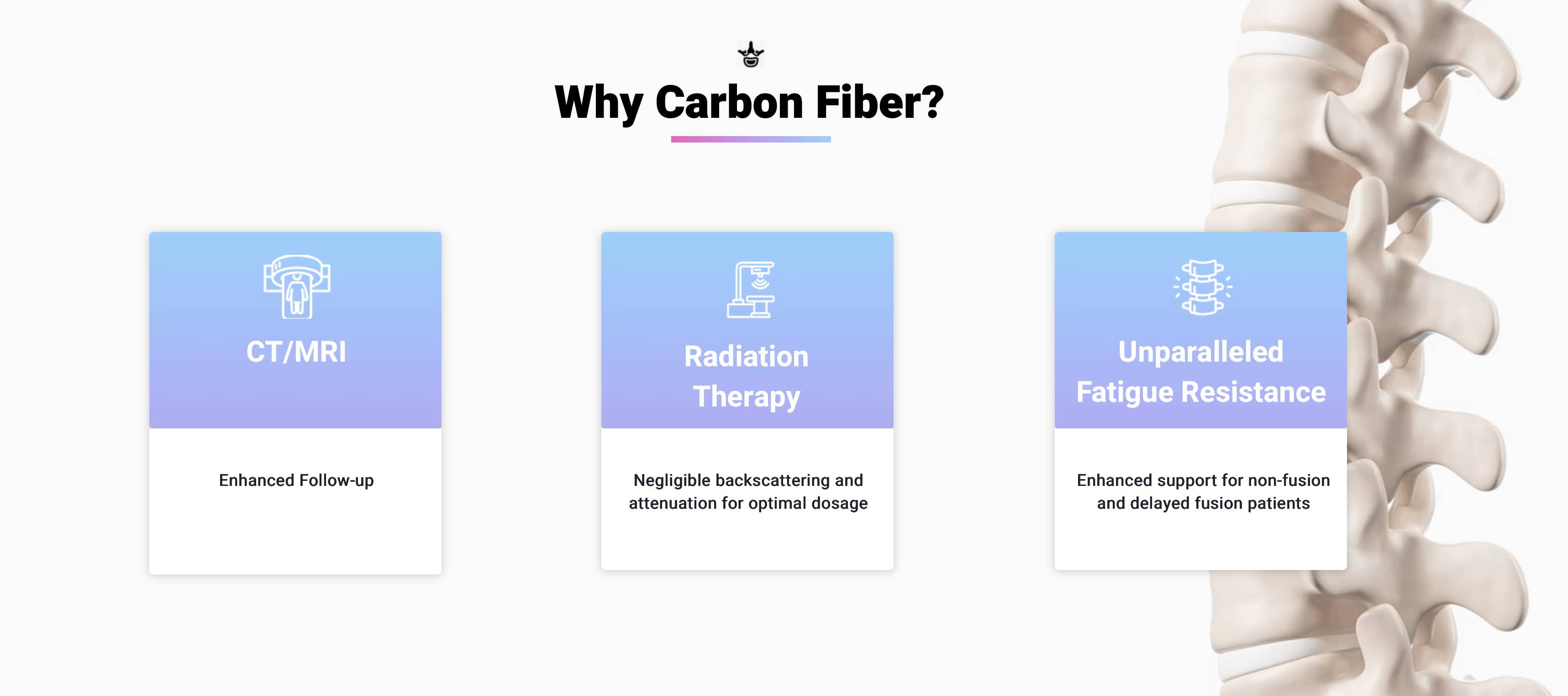
Three advantages make carbon-fiber implants especially valuable in the treatment of spinal tumors.
Artifact-free imaging means a tumor recurrence near the implant can be spotted early, enabling enhanced follow-up that metal hardware can obscure.
Negligible backscattering and attenuation let radiation oncologists deliver a more accurate dose to the tumor, with less collateral effect on healthy tissue.
Engineered for durability with a stiffness closer to bone than metal — offering strong support for non-fusion and delayed-fusion patients.
When a tumor weakens the spine, surgery is often needed to relieve pressure on the spinal cord and stabilize the bone. Many of these patients also need radiation therapy — either before or after surgery — and lifelong imaging to watch for recurrence. This is exactly where the choice of implant material matters most.
The best implant depends on your diagnosis and treatment plan. Dr. Hobbs selects the material that gives you the safest result and the clearest path for any imaging or radiation you may need.
Carbon-fiber implants are particularly valuable for patients whose care depends on clear imaging and precise radiation therapy.
If you or a loved one has a spinal tumor, Dr. Hobbs can explain whether carbon-fiber implants are part of the right surgical plan — coordinated with your oncology and radiation team. Call today to schedule a consultation.
(219) 250-5010Monday – Friday · 8:00 AM – 5:00 PM
500 E. 109th Avenue
Crown Point, IN 46307
601 Gateway Boulevard
Chesterton, IN 46304